The Road to Financial Unfreedom — Introduction to US Stock Options (Part 1)
Outline
Understanding Options
US stocks, as the name suggests, are stocks traded on US exchanges. So, what exactly is an option?
An option is a right that allows its holder to buy or sell a specified amount of underlying stock at a predetermined price (the strike price) on or before a future date. This right is tradable in the US stock market, and the price for trading this right is called the premium.
Option Operations
The minimum trading unit for options is a “lot,” where one lot consists of 100 contracts, corresponding to the right to trade 100 shares of the underlying stock. Options are divided into call options (Call) and put options (Put).
In the US stock market, the entire trading mechanism is completely fair. You can buy a call option or sell a call option, and the same applies to put options. This means there are a total of four types of option operations:
- Buy Call (Long Call)
- Sell Call (Short Call)
- Buy Put (Long Put)
- Sell Put (Short Put)
Options also have two concepts, in-the-money (ITM) and out-of-the-money (OTM), based on a comparison between the strike price and the current stock price. In-the-money means the option currently has intrinsic value, i.e., it would be profitable if exercised. Conversely, out-of-the-money options have no intrinsic value; they are essentially worthless. Holders of out-of-the-money options generally do not exercise them.
Next, let’s look at the four option scenarios, considering in-the-money and out-of-the-money concepts:
Buy Call (Long Call)
Buying a call option means you acquire the right to buy stock at a predetermined price (the strike price) at a future date. Let’s say it’s November 10, 2020. Microsoft stock is trading at $200 per share. You buy one Microsoft call option with a strike price of $220 and an expiration date of December 10, 2020, for $20. Your total cost is $2000. By December 10, two scenarios are possible:
In-the-Money (ITM) Microsoft’s stock price rises to
$300, which is above the option’s strike price of$220. This is an in-the-money option, and you would choose to exercise it because it’s profitable. Exercising means you buy 100 shares of Microsoft stock at the option’s strike price of$220, and then you can immediately sell them at the current market price of$300.Your profit would be:
(股票当前价 - 行权价) * 股数 - 期权权利金价格 * 张数 * 100 : (300 - 220)* 100 - 20 * 100 = 6000
 This means a net profit of `$6000`.

2.  Out-of-the-Money (OTM)

 Microsoft's stock price falls to `$180`, which is below the option's strike price of `$220`. At this point, the option has no profit potential and is out-of-the-money.
 If you were to exercise, it would mean buying 100 shares of Microsoft stock at the option's strike price of `$220`. However, the current market price is only `$180`, so buying at `$220` would result in a loss. Therefore, the option holder would not exercise. If you don't exercise, and the option expires, your loss would be the `$20` premium paid for the option (totaling `$2000`).

#### Option Trading

Of course, exercising isn't the only way to profit from options; options themselves are tradable.

Using the same example, if Microsoft's stock price rises to `$300`, exercising the option would require buying 100 shares of Microsoft stock and then selling them to realize a `$6000` profit. This would tie up `$220 * 100 = $22,000` in capital to buy Microsoft shares. But what if you don't have that much capital?

You can choose to trade the option directly. When Microsoft stock was at `$200` per share, the December 10, 2020, `$220` call option was selling for `$20`. When Microsoft's price rises to `$300`, this option itself will increase in value to at least `$300 - $220 = $80` (option prices are influenced by many factors, primarily the current stock price and time to expiration). At this point, if you choose not to exercise but instead sell the option directly, your profit would be:

<!-- more -->
(期权当前价 - 期权买入价) * 100 : (80 - 20) * 100 = 6000
As you can see, your profit is still `$6000`, but your capital outlay was only: `$20 * 100 = $2000`.
Compared to exercising, your profit is the same at `$6000`. However, exercising requires a capital outlay of `$22,000`, whereas selling the option directly only requires `$2000`. This is essentially 10x leverage, which is why many people choose to speculate using options.
#### Profit/Loss Curve
A profit/loss curve provides a visual understanding of the option's value relationship with the current stock price:
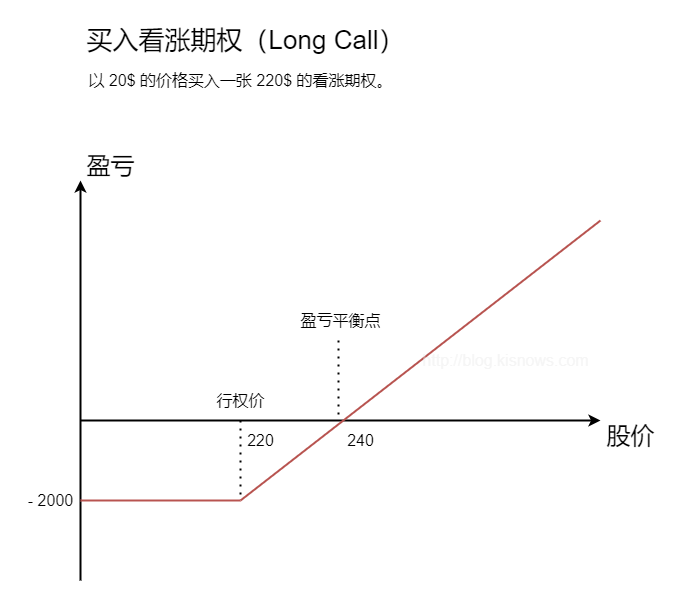
- Maximum loss is the option premium paid.
- Maximum profit increases as the stock price rises, with no upper limit.
### Sell Call (Short Call)
This means I have sold a call option, and the option buyer has the right to buy stock from me at the strike price at some point before expiration. Generally, you would choose to sell a call option at a certain strike price if you believe the stock will not rise above that price.
#### Profit/Loss Curve
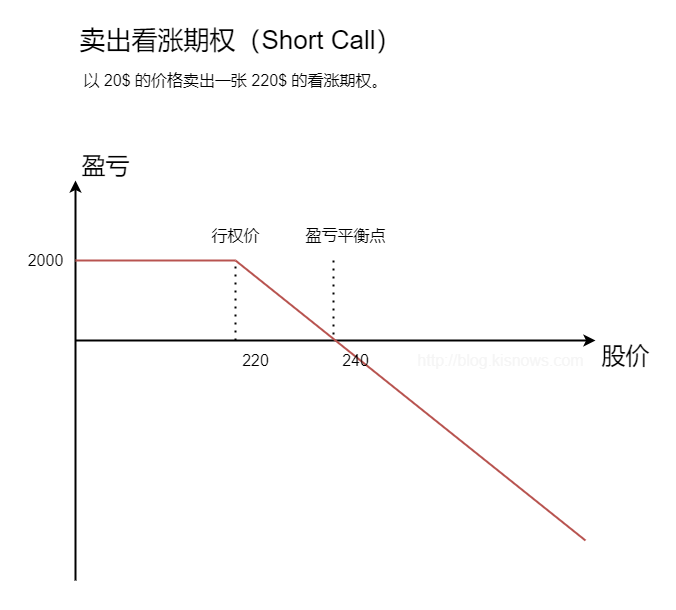
- Maximum loss is unlimited.
- Maximum profit is the option premium received.
### Buy Put (Long Put)
Buying a put option means you have the right to sell a specified number of shares at the strike price before expiration.
#### Profit/Loss Curve
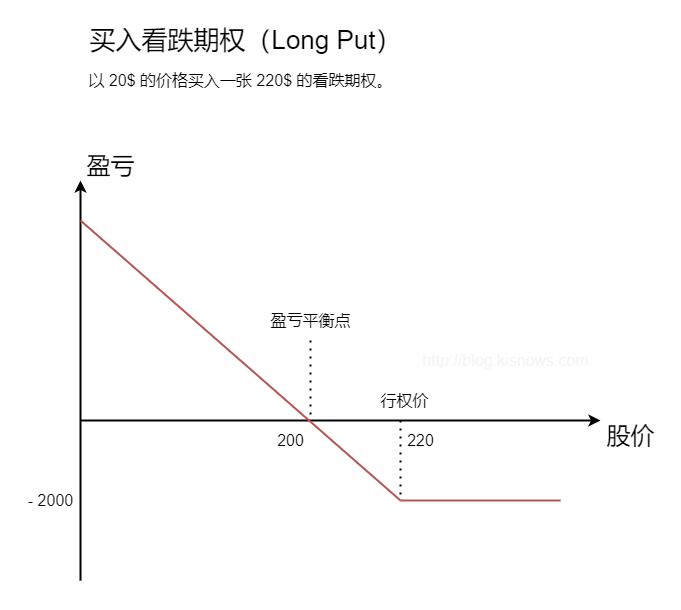
- Maximum loss is the option premium paid.
- Maximum profit increases as the stock price falls, reaching its maximum when the stock price drops to zero.
### Sell Put (Short Put)
Requires buying a specified number of shares at the strike price.
Both selling call options (short call) and selling put options (short put) are considered "short" positions, meaning that if you do not close your position before the option's expiration, you are obligated to fulfill the option's terms: selling calls requires you to sell the underlying stock at the strike price, and selling puts requires you to buy the underlying stock at the strike price. Both require margin in your account and are considered high-risk operations because potential losses can be unlimited.
#### Profit/Loss Curve
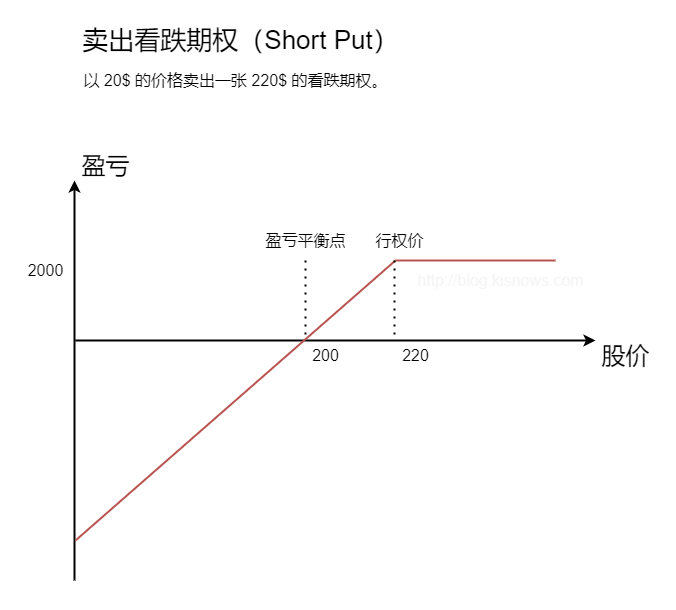
- Loss increases as the stock price falls, maximizing when the stock price drops to zero.
- Maximum profit is the option premium received.
## Factors Affecting Option Prices
Key factors influencing option prices are:
- **Strike price**: The price at which the option holder and seller agree to exchange the underlying stock.
- **Expiration date**: If the option holder does not exercise their right by this date, the option expires worthless. Within the expiration period, the option holder can choose to exercise at any time.
The expiration date, strike price, and current price of the underlying stock are the three factors that determine an option's price.
For example, if Microsoft's current price is `$200` per share, a call option with a strike price of `$180` will always be priced higher than `$200 - $180 = $20`. Additionally, prices vary depending on the length of time until expiration; generally, the longer the time to expiration, the higher the price.
## Uses of Options
Options have many uses. If you're not speculating, they are typically used in conjunction with the underlying stock.
### An Example
For example, suppose I hold 100 shares of Microsoft at a cost of `$200` per share, and my six-month target return is 10%. This means if Microsoft rises from `$200` to `$220` within six months, I've reached my goal and should sell. In this scenario:
- Directly selling the underlying stock yields `$220 * 100`, with a profit of `($220 * 100 - $200 * 100) = $2000`.
- Alternatively, I could sell one Microsoft call option with a strike price of `$220` expiring in six months, receiving a premium of `$25` (per share, so `$2500` total). If the stock price also rises to `$220`:
- The option holder would exercise, and my profit would be the profit from selling the underlying stock plus the `$25` premium.
If the stock price does not reach `$220` within six months, I would not sell the underlying stock. Compared to not selling the option, I would gain an additional `$25` (per share) in option premium.
This is just a simple example of using options; there are many other combination strategies to explore for more complex scenarios.
## Summary
Options are derivatives of stocks and allow for two-way, two-sided trading, referring to the four operations mentioned earlier. They are generally used in conjunction with the underlying stock for hedging to reduce risk.
However, due to options' inherent leverage, which can amplify both gains and losses, people often use option trading for speculation.
And I am one of those speculators:

Finally, if you're interested in US stocks, you can use my invitation to register with Longbridge Securities for US stock trading. Longbridge Securities is a professional US stock brokerage offering US stock trading services. Registration link: [Longbridge Securities](https://activity.lbkrs.com/pipeline/2023welcomegift/index.html?account_channel=lb&app_id=longbridge&org_id=1&businessType=activity&lbFitsStatusBar=0&lang=zh-CN&channel=HM2023002&code=YQ1709210200&refer-uri=https%253A%252F%252Factivity.lbkrs.com%252Fpipeline%252F2023welcomegift%252Findex.html%253Faccount_channel%253Dlb%2526app_id%253Dlongbridge%2526org_id%253D1%2526businessType%253Dactivity%2526lbFitsStatusBar%253D1%2526channel%253DHM2023001%2526lang%253Dzh-HK&sac=lb&redirect_url=https%3A%2F%2Factivity.lbkrs.com%2Fpipeline%2F2023welcomegift%2Findex.html%3Faccount_channel%3Dlb%26app_id%3Dlongbridge%26org_id%3D1%26channel%3DHM2023002%26code%3D%26refer-uri%3Dhttps%25253A%25252F%25252Factivity.lbkrs.com%25252Fpipeline%25252F2023welcomegift%25252Findex.html%25253Faccount_channel%25253Dlb%252526app_id%25253Dlongbridge%252526org_id%25253D1%252526businessType%25253Dactivity%252526lbFitsStatusBar%25253D1%252526channel%25253DHM2023001%252526lang%25253Dzh-HK%26sac%3Dlb%26businessType%3Dactivity%26lbFitsStatusBar%3D0%26lang%3Dzh-CN&invite-code=265638)This article was published on November 11, 2020 and last updated on October 13, 2025, 372 days ago. The content may be outdated.